
More About…
Ally

I've spent a lifetime loving animals. Reverent Paws grew from learning to truly listen to them. Not to offer a checklist of services, but to build relationships with animals and their humans around observation, communication, trust, and respect. It starts with paying attention. Recognizing what an animal is communicating. Understanding that their needs may change from one day to the next. And being willing to adjust our expectations instead of asking them to adjust who they are.
Animals have been a part of my life long before Reverent Paws had a name. I grew up with black Labs who weren't simply family pets — they were working retrievers. They had jobs, purpose, and an extraordinary relationship with the people who understood them. We also had snakes, rabbits, gerbils & guinea pigs, fish, birds, and my cousins had cats and more country animals like horses, pigs and chickens.
As an adult, my own animals taught me very different lessons. About purpose and enrichment. Medical fragility. Fear and behavior. Trust, grief, and the enormous responsibility that comes with loving an animal who doesn't fit neatly into the world. Some needed a job. Some needed patience. Some needed accommodations. And some needed me to understand that love, no matter how enormous, doesn't automatically give us all the answers. Eventually, that love and curiosity led me into rescue and shelter work.
Good care starts long before the leash goes on.
I began volunteering, fostering, walking and handling dogs, participating in enrichment and supervised playgroups, transporting animals, and learning alongside people who have dedicated their lives to understanding behavior and improving the lives of all animals everywhere. I am truly grateful for all the teachers I’ve had through my life, but some of my greatest teachers were the dogs themselves.
The ones who needed space before affection. The ones whose excitement was mistaken for disobedience. The ones who communicated their fear so quietly it was easy to miss. And the ones who reminded me that progress doesn't always look the way we expect it to.
Reiki found its way into this work almost unexpectedly. I was already a Reiki Master when a trainer suggested I spend time with a particularly anxious dog. What began as an invitation to offer something different became another opportunity to observe, slow down, and allow the animal to guide the interaction. Not as a substitute for veterinary care, training, or behavioral support, but as another way of offering calm companionship without expectations or demands. And somewhere along the way, all of these experiences began pointing toward the same thing.
Meet them where they are. Care for who they are.
Reiki Master • Dogs Playing for Life Graduate • Rescue & Shelter Volunteer
Jack

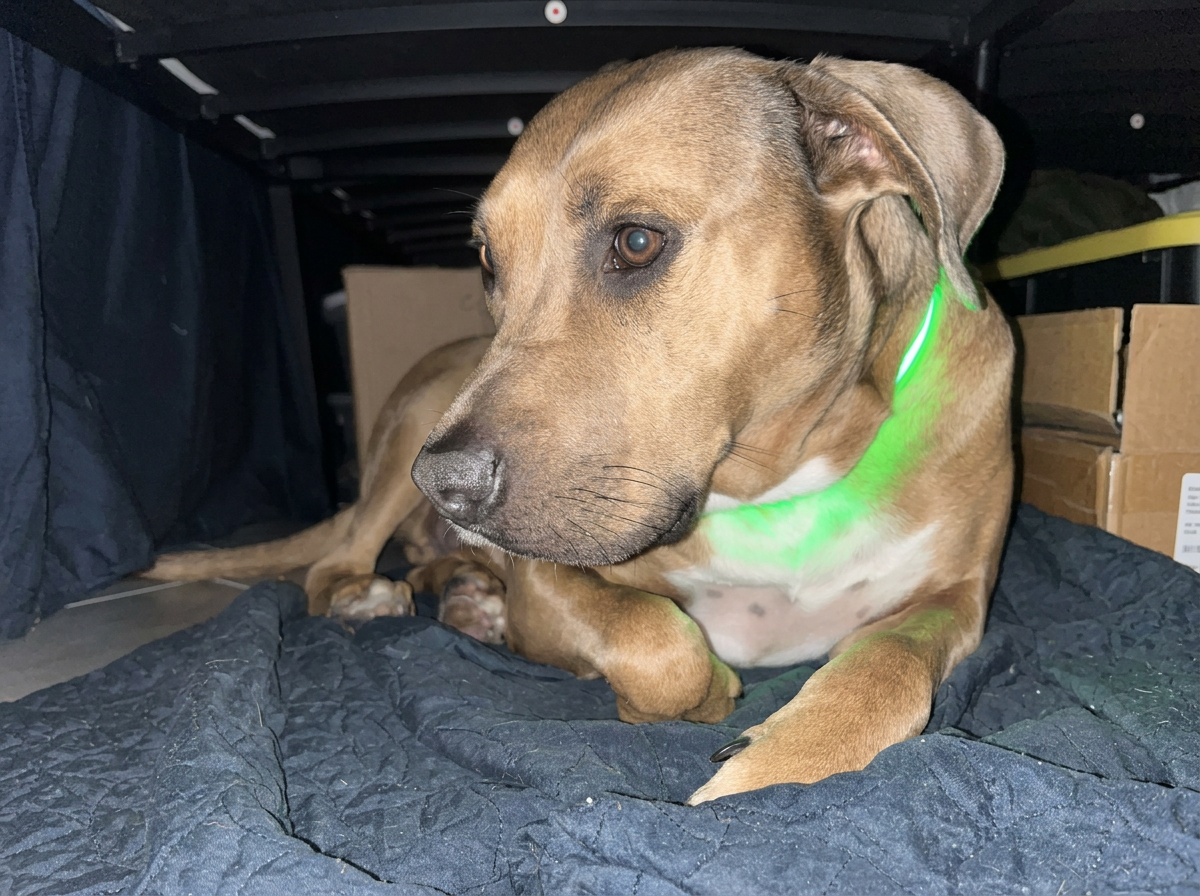
Jack came into my life through the shelter as a very sick pup. He was filthy, covered in fleas, and had a wound on the back of his neck where a collar may have grown too tight or another animal had hurt him. He smelled absolutely horrible. But then he wove himself between my legs, sat down, and looked up at me with those enormous brown eyes. He came home with me for Thanksgiving weekend and, well, he never went back. That's what we call a foster fail. Best failure of my life.
Jack was different from every dog I'd had before. I hadn't met his parents, chosen him from a litter, or raised him from puppyhood. And because he'd been so sick when he arrived at the shelter, there was still so much nobody knew about him. For the first time, I was getting to know a dog without knowing much of his story. I had to earn his trust and figure out his quirks, preferences, passions, fears, and triggers. And let me tell you, Jack has opinions.
He loves the water but hates to swim. He adores anything dairy but considers carrots and apples beneath him, unless there's peanut butter involved. His stomach has its own very specific requirements, and he has some equally strong feelings about intact male dogs. He loves rough-and-rowdy play, especially when it turns into a good game of chase. He's also the most expressive dog I've ever known. His face, his posture, his eyes — he has an entire vocabulary, and he's not particularly subtle about using it. And he's smart. Scary smart.
But Jack also watches the sky. Fireworks, thunder, lightning, and sudden loud noises can send him into a panic, and when he's frightened, his instinct is to run. Keeping him safe means recognizing the signs before fear takes over, understanding what helps him cope, and accepting that some things aren't necessarily problems to fix. They're realities we learn to work with.
And then there's his quieter side. Jack loves to be nearby when I'm practicing Reiki or meditating. He'll settle in and keep me company, perfectly content to share the space without needing anything from me. For all his enthusiasm, mischief, and occasional theatrics, there's something wonderfully soulful about him. I often say he's an old soul in a young heart and body. He can go from wild, exuberant play to peaceful companionship, and both are equally Jack.
Living with him has reinforced something my shelter work had already begun teaching me: behavior is communication. Fear is communication. Excitement is communication. Avoidance is communication. So are curiosity, enthusiasm, hesitation, and the decision to walk away. Understanding what an animal is telling us doesn't necessarily mean changing who they are.
Sometimes we teach, sometimes we build confidence, and sometimes we manage the world differently. And sometimes our job is simply to listen. Jack didn't need me to turn him into the dogs I'd known before him. He needed me to get to know him.
Jack is a big part of why Reverent Paws exists.
Intentional Care
Every animal has their own personality, preferences, routines, fears, and ways of communicating. And just like us, what they need can change from one day to the next. Intentional care begins with getting to know the animal in front of me, rather than assuming that what worked yesterday, or what works for another animal, is necessarily right for them today.
Sometimes care looks like a walk, a game of fetch, or an opportunity to explore somewhere new. Sometimes it's enrichment, practicing a familiar skill, or building confidence through a new experience. And sometimes it's recognizing that an animal is tired, uncomfortable, anxious, or overwhelmed, and that what they need most isn't more activity or stimulation. It's patience, reassurance, and a chance to feel safe.
My dog Jack is a perfect example. He's adventurous, playful, ridiculously smart, and absolutely terrified of fireworks and thunderstorms. Loving him didn't mean teaching that fear out of him. It meant learning to recognize his signals, understanding what helps him cope, and knowing when to change our environment or expectations. On those days, success isn't measured in miles walked or activities completed. It's knowing that he feels supported and that I've done what I can to help him feel secure.
That same philosophy guides how I care for other animals. I pay attention to body language, energy, comfort, and engagement. I want to know what makes an animal curious, what helps them relax, what motivates them, and what they would rather avoid. I believe in offering opportunities without forcing participation, encouraging growth without creating unnecessary pressure, and recognizing that doing less can sometimes accomplish more.
This doesn't mean abandoning structure, routines, or expectations. Those things can be incredibly important, especially for animals who find comfort in predictability. It means being thoughtful about how we use them and flexible enough to recognize when something isn't working.
Intentional care isn't about completing the plan. It's about noticing when the plan needs to change.
Because the goal isn't simply to fill the time you've booked. It's to make that time meaningful for the animal who spends it with me.
More About Reiki
Energy, Rivers & the Art of Letting Go
The easiest way I know to explain Reiki is to imagine rivers running through your body.
In traditional Reiki and other energy-based practices, we think of living things as having energy flowing through them. You may have heard of chakras or meridians, the pathways associated with practices like acupuncture. I like to imagine those pathways as a network of rivers, each with its own current, all connected in one way or another.
Now imagine what happens when rocks fall into a river. A few small stones might barely interrupt the current. The water simply finds its way around them. But over time, more rocks collect. Maybe a branch gets caught, then another, until eventually there's a pretty substantial obstruction. The river hasn't disappeared, but the way it flows has changed.
That's how I think about the effects of stress, fear, grief, injury, and the experiences we carry with us. Some things pass through us easily. Others seem to linger. In the language of Reiki, we might describe those experiences as disruptions or blockages in the flow of energy.
Reiki is a Japanese practice traditionally understood as working with that energy. As a Reiki Master, I use gentle touch or work with my hands just above the body, with the intention of supporting balance, calm, and relaxation. I don't think of myself as fixing someone or removing their problems. I think of it more like helping create space around those rocks, allowing the river to find its own way.
It's a metaphor for how I understand the practice, rather than a medical explanation of how the body works. Reiki isn't a substitute for veterinary care, medical treatment, or behavioral support. But it can be a quiet, comforting experience, and one that asks very little of the animal receiving it.
A Dog Beneath a Tree
Reiki became part of my work with animals almost by accident.
I was already a Reiki Master when a trainer at the shelter asked me to spend some time with a dog who was experiencing extreme kennel stress. Anyone who's spent time in a busy shelter knows how overwhelming that environment can be. The barking, the activity, the unfamiliar smells, the constant stimulation. For some dogs, it's simply too much.
I took him out for a walk, and we eventually found a quiet place beneath a tree. We sat together for a while. I hummed and chanted softly, petted him with one hand, and incorporated a Reiki symbol with the other. There was no elaborate ceremony, no expectation that he needed to do anything, and certainly no promise that I could make his anxiety disappear.
We just spent some time together, away from the noise.
When he seemed calmer, we walked back to his kennel, and I sat with him a little longer before leaving.
He wasn't cured. He was still a dog living in a stressful environment, and I couldn't change that in a single afternoon. But he had a chance to settle, and I had an opportunity to connect with him without asking anything in return.
That experience stayed with me. I began spending more time with some of the shelter's more challenging dogs, learning to recognize when they needed encouragement, when they needed space, and when simply being present was enough.
It reinforced something I'd been learning through my shelter work all along: not every interaction needs a goal beyond helping an animal feel comfortable and understood.
Reiki With Animals
Animals don't arrive at a Reiki session with an understanding of chakras, meridians, or energy work. They don't know what I've planned, and they certainly haven't agreed to sit still for thirty minutes while I carry it out.
And that's exactly why I approach animal Reiki differently.
I begin by observing. Does the animal seem curious? Comfortable? Interested in being touched? Would they rather keep their distance? Some animals settle beside me. Others move around, approach and retreat, or choose to rest somewhere nearby. All of those responses are information, and I respect them.
I may offer gentle touch, work without touching, or simply sit quietly and allow the animal to decide how close they want to be. There is no requirement to participate, and I don't interpret an animal walking away as a failure.
For animals experiencing stress, changes in routine, aging, or periods of limited activity, this kind of quiet companionship may be especially welcome. Reiki is offered as a complementary wellness practice, not a medical treatment, and it does not replace veterinary guidance or prescribed care.
I don't promise that Reiki will heal an injury, resolve anxiety, or change behavior. What I can offer is a calm environment, patient attention, and an interaction that respects the animal's comfort and choices.
And that brings me back to the rivers.
You don't force the river to flow, just as you don't force an animal to participate.
Sometimes the most meaningful thing we can do is make room for what happens naturally.
Before I care for your animals, I’d like to meet them!
Every new relationship begins with a complimentary Meet & Greet + Animal Profile in your animal's own environment.
We'll talk about who they are, what they love, what they avoid, their routines, their quirks, their history and what helps them feel safe and understood.
And just as importantly, they get to meet me.