
More about Reiki
An ancient Japanese practice. A little philosophy. A lot of presence.
And absolutely no requirement that you or your animals believe in any of it.
What Is Reiki?
Reiki (pronounced ray-key) is a Japanese spiritual practice traditionally associated with relaxation, balance, and well-being. It involves gentle touch, or placing the hands just above the body, with the intention of supporting a sense of calm.
The word Reiki combines two Japanese concepts:
Rei — often interpreted within Reiki traditions as spiritual wisdom, universal consciousness, or a higher guiding presence.
Ki — life-force energy, a concept found in several Eastern philosophical traditions.
Together, Reiki is commonly understood by practitioners as spiritually guided life-force energy.
In traditional Reiki teachings, this energy is believed to flow through living things. Practitioners work with the intention of encouraging balance and supporting the body's natural capacity for rest and well-being.
That's the spiritual understanding of Reiki. Scientifically, the existence of this proposed energy field has not been established, and Reiki has not been proven to treat medical conditions.
For me, Reiki is also something beautifully practical: an invitation to slow down, become present, and pay attention to another living being without expecting anything in return.
Especially when that living being has four legs, a tail, and absolutely no interest in following my agenda.
Spiritual, Not Religious
Reiki is spiritual in nature, but it is not a religion. It has no required religious affiliation, no formal doctrine of worship, and no particular belief system you must adopt to participate. Some practitioners understand Reiki through their existing religious faith. Others approach it through meditation, mindfulness, connection with nature, or a personal sense of spirituality.
Traditional Reiki teachings sometimes use words such as Higher Power, or universal energy. Those expressions reflect different ways people have interpreted the spiritual aspects of the practice. You don't need to share my or any beliefs to explore Reiki, and I have no interest in convincing you to adopt them.
I believe there is room for curiosity, spirituality, skepticism, and a healthy dose of common sense to coexist. And the animals? They don't care what we call it. They respond to what they experience: our movements, our voices, our attention, our touch, and whether they feel comfortable enough to stay.
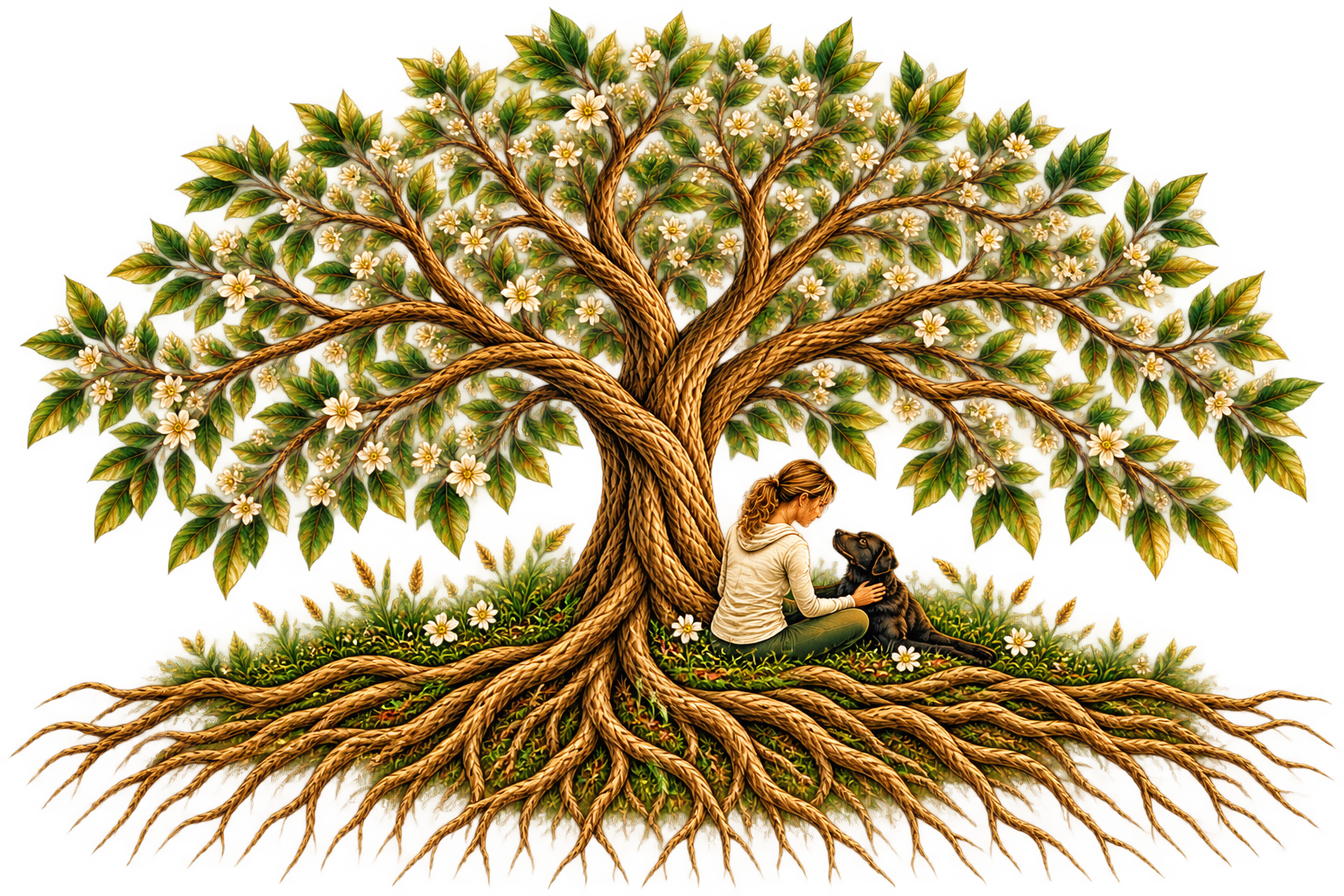
A Dog Beneath a Tree
Sometimes the greatest gifts are the ones we never saw coming.
Reiki came into my life as a gift. Quite literally. I was attending a yoga teacher training when someone who would eventually become my Reiki Master and Teacher came to our class and offered each of us our first Reiki initiation. I didn't know exactly what I had been given that day, or where it would lead. But somehow, I knew it was going to change my life. I just had absolutely no idea how much.
Years later, I found myself sitting beneath a tree with a dog who was having a particularly difficult time. I was volunteering at an animal shelter when a trainer asked me to spend some time with a dog experiencing extreme kennel stress. If you've ever walked through a busy shelter, you know how overwhelming that environment can be. The barking, the unfamiliar smells, the constant activity, the endless parade of strangers. For some dogs, it's simply too much. So we went for a walk.
Eventually, we found a quiet place beneath a tree, away from the noise and commotion. We sat together for a while. I hummed and chanted softly, petting him with one hand while incorporating a Reiki symbol with the other. There was no elaborate ceremony. No expectation that he needed to do anything. And certainly no promise that I could make his anxiety disappear. We just spent some time together. When he seemed calmer, we walked back to his kennel, and I stayed with him a little longer before leaving.
He wasn't cured. He was still a dog living in a stressful environment, and I couldn't change that in a single afternoon. But he'd had a chance to settle. And for a little while, he had someone sitting beside him who wasn't asking anything of him.
That experience stayed with me. I began incorporating Reiki more intentionally into my time with Jack, the dogs I encountered through my volunteer work, and the animals belonging to friends who welcomed me into their lives. Animals have been some of my greatest teachers. Some leaned into my hands. Some preferred that I keep them to myself. Some settled beside me, while others wandered off to investigate something infinitely more interesting. Apparently, spiritual enlightenment is no match for a particularly compelling smell.
I learned to pay attention to the smallest things. A shift in posture. A deep breath. A curious glance. The decision to move closer, or the equally important decision to walk away.
I learned that offering Reiki to an animal isn't about convincing them to participate. It's about making the invitation and respecting their answer. And somewhere along the way, something else happened… The practice I had once received as a gift became a meaningful part of the way I cared for and connected with animals. What began with my own spiritual journey gradually found its way into my volunteer work, my relationships, and eventually, the very heart of Reverent Paws.
I still believe Reiki changed my life. I just never imagined that one day I'd be sitting beneath a tree, sharing that gift with a shelter dog who had no idea what Reiki was and couldn't have cared less.
I've come to think that's part of its beauty.
Reiki has taught me a great deal about presence, patience, gratitude, and the importance of allowing things to unfold without trying to control the outcome.
And the animals have helped me put those lessons into practice.
I'm profoundly grateful to the teacher who first shared Reiki with me, to every animal who has allowed me to explore this practice alongside them, and to the unexpected path that brought me here.
What began as a gift to me has become something I am deeply happy and honored to share with your revered animals, too.
And if you ask me, that's a pretty beautiful way for a gift to keep on giving.
The Roots of Reiki
The system of Reiki practiced around the world today is largely associated with Mikao Usui (1865–1926), a Japanese spiritual practitioner who developed and taught his approach in the early twentieth century. Usui's teachings combined spiritual development, meditative practices, hands-on techniques, and a set of ethical principles intended to encourage harmony in everyday life.
Although Reiki is often introduced as a healing technique, its philosophy extends beyond what happens during a session. At its heart is an invitation to consider how we move through the world, how we treat others, and how we respond to life's difficulties.
That philosophy resonates deeply with the work I do with animals. Because kindness, patience, and presence aren't techniques we turn on for thirty minutes. They're practices we carry into the rest of our lives.

Energy, Rivers & the Art of Letting Go
The easiest way I know to explain Reiki is to imagine rivers running through your body.
In traditional Reiki and other energy-based practices, we think of living things as having energy flowing through them. You may have heard of chakras or meridians, the pathways associated with practices like acupuncture. I like to imagine those pathways as a network of rivers, each with its own current, all connected in one way or another.
Now imagine what happens when rocks fall into a river. A few small stones might barely interrupt the current. The water simply finds its way around them. But over time, more rocks collect. Maybe a branch gets caught, then another, until eventually there's a pretty substantial obstruction. The river hasn't disappeared, but the way it flows has changed.
That's how I think about the effects of stress, fear, grief, injury, and the experiences we carry with us. Some things pass through us easily. Others seem to linger. In the language of Reiki, we might describe those experiences as disruptions or blockages in the flow of energy.
Reiki is a Japanese practice traditionally understood as working with that energy. As a Reiki Master, I use gentle touch or work with my hands just above the body, with the intention of supporting balance, calm, and relaxation. I don't think of myself as fixing someone or removing their problems. I think of it more like helping create space around those rocks, allowing the river to find its own way.
It's a metaphor for how I understand the practice, rather than a medical explanation of how the body works. Reiki isn't a substitute for veterinary care, medical treatment, or behavioral support. But it can be a quiet, comforting experience, and one that asks very little of the animal receiving it.
What Being a Reiki Master Means to Me
Being a Reiki Master doesn't mean I have all the answers. It doesn't mean I can heal every hurt, quiet every fear, or make difficult things disappear.
It means I've committed myself to learning and practicing a tradition that asks me to be intentional about how I show up in the world.
I believe in energy. I believe in connection. I believe that our presence affects the living beings around us, sometimes in ways we don't fully understand.
I also believe in science, veterinary medicine, dietary needs, behavioral expertise, and knowing the difference between what I believe and what I can demonstrate. Those things don't have to be enemies.
My Reiki practice is spiritual. My approach to animals is practical. And the two meet in a place that feels very natural to me: compassion without expectation. Prioritizing peace and presence above performance.
I don't need an animal to understand Reiki, believe in it, or even participate in it. I simply want to offer a moment in which nothing is being demanded of them.
Reiki With Animals
Animals don't arrive at a Reiki session with an understanding of chakras, meridians, or energy work. They don't know what I've planned, and they certainly haven't agreed to sit still for thirty minutes while I carry it out.
And that's exactly why I approach animal Reiki differently.
I begin by observing. Does the animal seem curious? Comfortable? Interested in being touched? Would they rather keep their distance? Some animals settle beside me. Others move around, approach and retreat, or choose to rest somewhere nearby. All of those responses are information, and I respect them.
I may offer gentle touch, work without touching, or simply sit quietly and allow the animal to decide how close they want to be. There is no requirement to participate, and I don't interpret an animal walking away as a failure.
For animals experiencing stress, changes in routine, aging, or periods of limited activity, this kind of quiet companionship may be especially welcome. Reiki is offered as a complementary wellness practice, not a medical treatment, and it does not replace veterinary guidance or prescribed care.
I don't promise that Reiki will heal an injury, resolve anxiety, or change behavior. What I can offer is a calm environment, patient attention, and an interaction that respects the animal's comfort and choices.
And that brings me back to the rivers.
You don't force the river to flow, just as you don't force an animal to participate.
Sometimes the most meaningful thing we can do is make room for what happens naturally.
Follow the Quiet Conversation, Schedule a Meet and Greet!
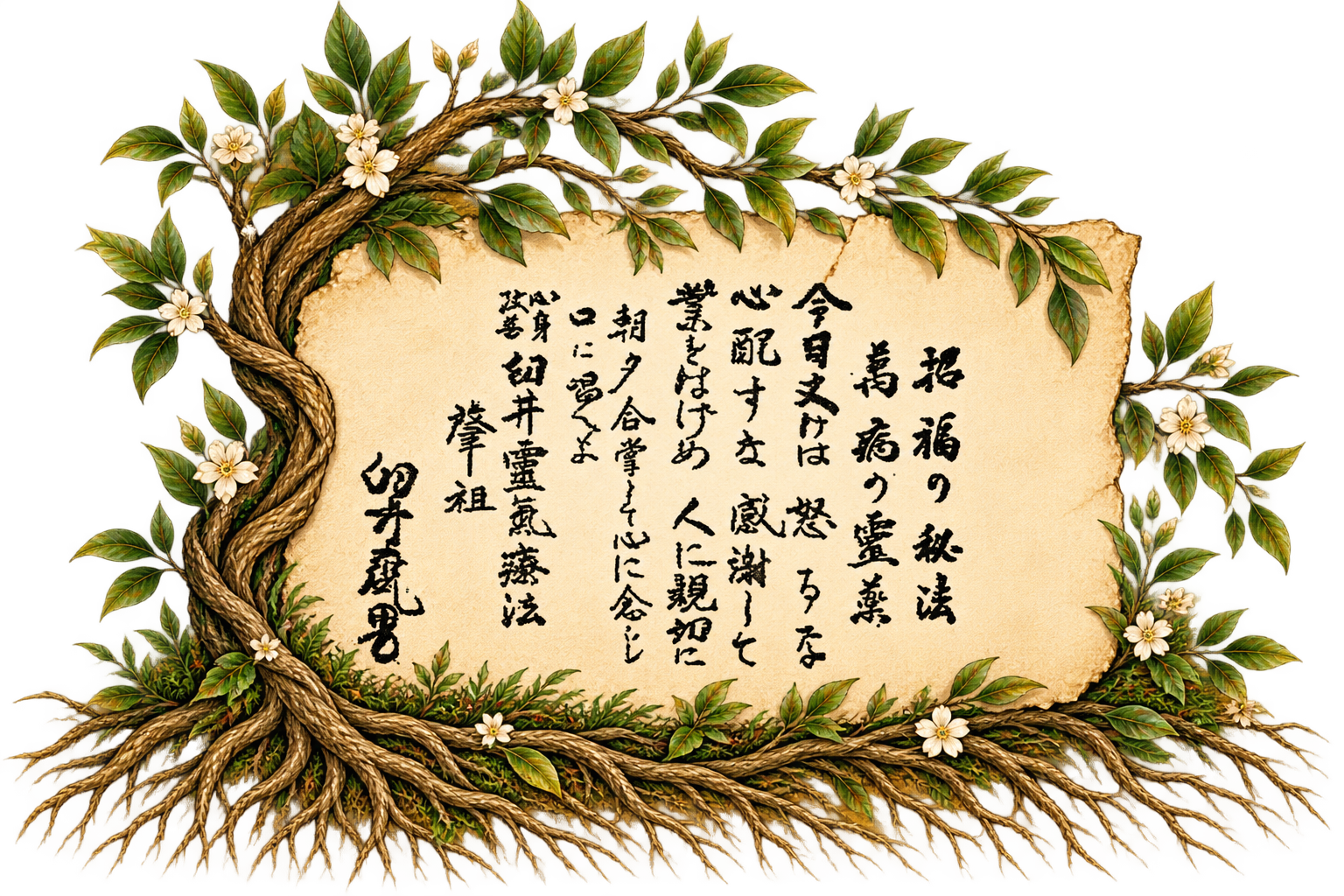
Just for Today:
The 5 Reiki Precepts
One of the most meaningful parts of Usui's teachings is a set of five principles, often called the Gokai, or Five Precepts. Translations vary, but their essential message is remarkably simple.
Just for today…
Do not anger.
Not because anger makes us bad, but because we can learn to recognize it without allowing it to determine every response.
Do not worry.
Not because worry is a personal failure, but because we can practice returning our attention to what is within our control.
Be grateful.
Notice what is present, what is meaningful, and what deserves appreciation, even when life is difficult.
Work diligently and honestly.
Approach your responsibilities and commitments with sincerity and integrity.
Be kind to others.
Extend compassion to the people and living beings who share your world.
I particularly appreciate the opening words: Just for today.
Not forever. Not perfectly. Not with the expectation that we'll never become angry, anxious, distracted, or overwhelmed again.
Just today.
Tomorrow, we practice again.